Hvantage Blog
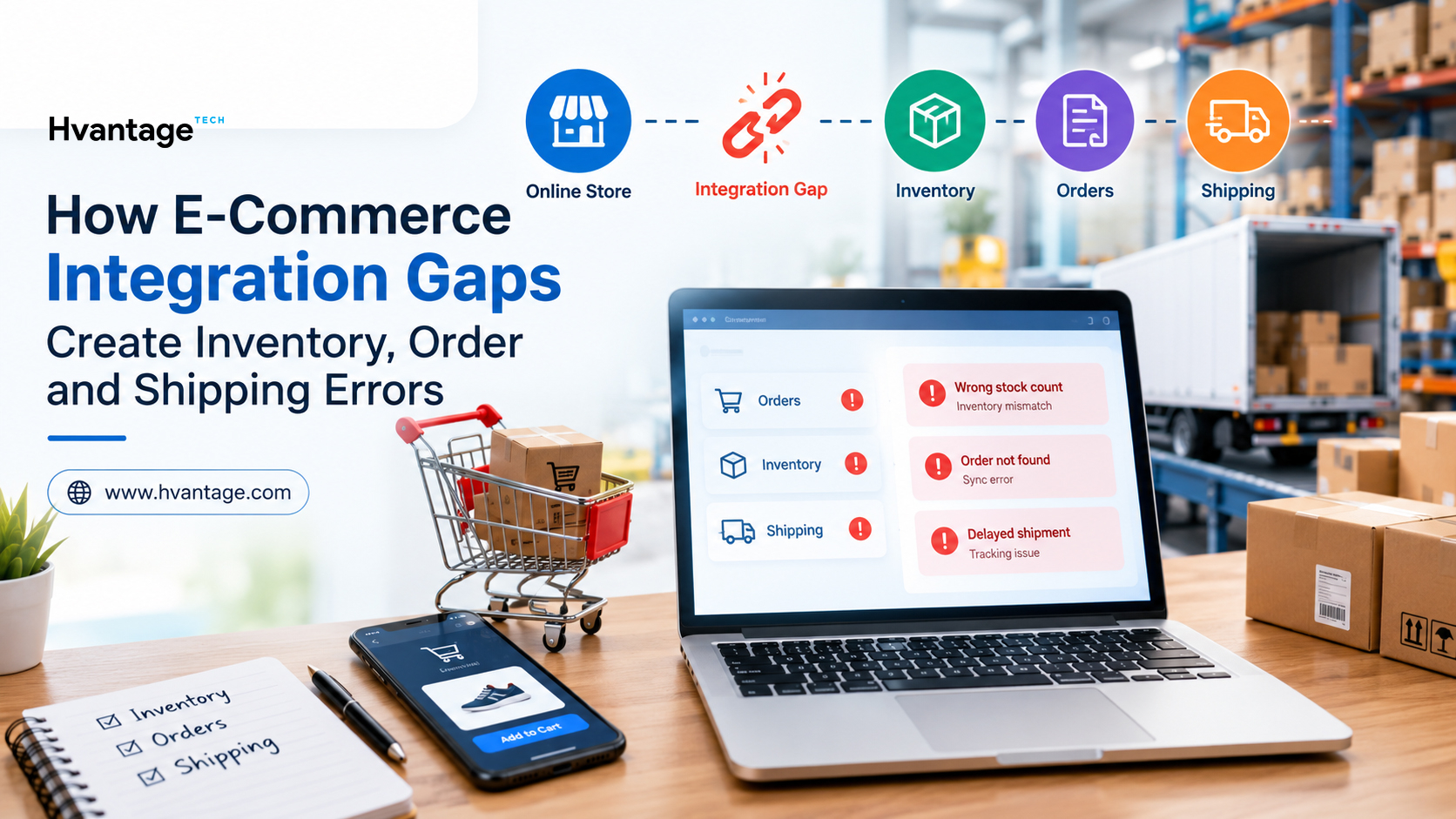
How E-Commerce Integration Gaps Create Inventory, Order and Shipping Errors
-
 by Hvantage
-
 Oct 24, 2026


Running an online store involves much more than publishing products and accepting customer payments. Behind every successful e-commerce transaction, several systems must work together to manage product information, inventory availability, order processing, payment confirmation, shipping and customer notifications.
Problems arise when these systems operate independently or fail to exchange information accurately. A product may appear available even after its stock has been depleted. An order may remain unprocessed despite a successful payment. A shipping label may contain outdated information, or a customer may receive a delivery notification that does not reflect the actual shipment status.
These problems often indicate gaps in e-commerce integration, data synchronization or workflow automation. Although individual software applications may function correctly, a lack of coordination between them can create operational problems throughout the order fulfillment process.
For growing online businesses, E-Commerce Integration Services help connect essential systems, establish reliable data flows and reduce unnecessary manual work. In this guide, we explore how integration gaps create inventory, order and shipping errors, how businesses can identify their underlying causes, and which technology strategies can help improve operational efficiency.
1. What Are E-Commerce Integration Gaps?
E-commerce integration gaps occur when an online store and its connected business applications cannot exchange information consistently, accurately or at the right time.
A typical e-commerce operation may use a website platform, inventory management software, an order management system, a payment gateway, accounting software and one or more shipping providers. Each system manages a different part of the business, but they depend on shared information to complete transactions successfully.
When these applications are poorly connected, employees may need to transfer information manually, repeat data entry or investigate discrepancies between systems. Even when integrations exist, incorrect configurations, failed API requests, delayed updates and inconsistent product identifiers can interrupt the flow of information.
Common Signs of E-Commerce Integration Problems
- Inventory mismatches: Product availability differs between the online store and inventory records.
- Order synchronization failures: Orders appear in one application but are missing from another.
- Payment status discrepancies: Payment confirmation does not match the order status.
- Shipping delays: Orders are not transferred to fulfillment or shipping systems on time.
- Incorrect tracking information: Tracking details are missing, outdated or associated with the wrong order.
- Duplicate records: Repeated integration requests create duplicate orders, notifications or other records.
- Manual reconciliation: Employees regularly compare spreadsheets and multiple applications to resolve discrepancies.
- Inconsistent product data: Product names, SKUs, prices or descriptions differ between connected systems.
Identifying these symptoms is the first step toward building a more reliable e-commerce integration strategy. The objective is not simply to connect applications, but to ensure that information moves between them accurately and that failures can be detected and resolved.
2. How Inventory Integration Gaps Lead to Stock Errors
Inventory accuracy is essential for online retail. Customers expect products displayed as available to be ready for purchase, while businesses need dependable stock information to plan replenishment and fulfill orders.
Without effective inventory management integration, an e-commerce website may display outdated stock levels or fail to account for orders placed through other sales channels.
Overselling Products That Are Out of Stock
Consider a retailer selling the same product through its website and an online marketplace. The inventory system records ten units, but several customers purchase the item within a short period.
If inventory updates are delayed or orders from different channels are not synchronized, each sales channel may continue displaying the same available quantity. Customers can then purchase more units than the business can fulfill.
This situation can result in cancellations, customer complaints, refund processing and additional support work.
Real-time inventory synchronization, where supported by the connected systems, can help maintain more consistent stock information. Businesses should also consider update frequency, concurrent orders, reserved stock and safety-stock rules when designing their inventory workflows.
Incorrect Stock Counts Across Multiple Channels
Multichannel retailers frequently manage inventory across websites, marketplaces, physical stores and warehouses. If each platform maintains an independent stock count without a reliable synchronization process, discrepancies can accumulate.
For example, a warehouse employee may update inventory in one system while the e-commerce platform continues using an older quantity. This can create inaccurate product availability and complicate replenishment decisions.
A properly designed inventory management system integration establishes clear rules for updating stock, recording reservations and reconciling changes across sales channels.
Product SKU and Identifier Mismatches
Inventory systems depend on consistent product identifiers to associate orders with the correct items. When a website uses one SKU format and a warehouse application uses another without an accurate mapping, stock movements may be recorded against the wrong product or fail to update entirely.
Businesses should maintain a reliable product master containing consistent SKUs, variant identifiers, product attributes and relevant warehouse references.
Why Inventory Synchronization Matters
An effective inventory integration workflow should define which system is authoritative for stock information, how frequently updates occur, how reserved quantities are calculated and what happens when an update fails.
These rules help reduce discrepancies and give operations teams a clearer understanding of product availability across the business.
3. How Disconnected Systems Create Order Processing Errors
An online order can pass through several stages, including order creation, payment authorization, payment confirmation, inventory allocation, fulfillment and shipment. Each stage depends on accurate information from the preceding steps.
When an e-commerce order management system is not properly integrated with other business applications, orders may become delayed, duplicated or incorrectly classified.
Orders Missing From Fulfillment Systems
A customer may complete checkout successfully, but the order might not appear in the warehouse or order management application. This can happen when an API request fails, a data mapping rule is incorrect or an integration process stops without generating an appropriate alert.
If no monitoring mechanism identifies the failure, the order may remain unprocessed until a customer contacts support.
E-commerce order processing automation can help transfer order information between systems, validate required fields and flag transactions that have not progressed through the expected workflow.
Duplicate Orders and Repeated Processing
Integration failures sometimes trigger automatic retries. If a system repeats a request without checking whether the original transaction was already processed, duplicate records or repeated actions may occur.
For example, a delayed response from an order management system may cause an integration to submit the same order again.
Developers can reduce this risk by implementing appropriate idempotency controls, unique transaction identifiers, duplicate detection and reliable retry policies.
Incorrect Order Status Updates
Customers and support teams depend on accurate order statuses. If the website displays an order as processing while the fulfillment system has already dispatched it, customer communication becomes confusing.
Similarly, an order might appear completed before the required fulfillment steps have finished if status mappings are incorrectly configured.
An integrated workflow should define the meaning of each status, the system responsible for updating it and the conditions under which a status transition is permitted.
Payment and Order Status Conflicts
Payment processing and order management are closely connected, but they are not identical. A payment may be authorized without being captured, a transaction may remain pending, or a payment provider may confirm a result after the original checkout request has timed out.
If these states are not handled correctly, the store may display misleading order information or trigger fulfillment at the wrong time.
Reliable payment gateway integration should account for authorization, capture, failure, refund and asynchronous confirmation events where applicable. Businesses should also reconcile payment records against orders instead of assuming that every transaction follows a single immediate response.
4. Why Shipping Integration Errors Cause Delivery Delays
Shipping begins after an order has been accepted for fulfillment, but successful delivery depends on accurate data moving between the e-commerce platform, warehouse operations and shipping providers.
Shipping API integration connects these systems so that businesses can transmit shipment details, request shipping labels, retrieve tracking information and update delivery statuses.
Shipping Labels Generated With Incorrect Information
Shipping systems require accurate recipient addresses, contact details, package dimensions, weight and service selections. Incorrect or incomplete information can result in rejected shipment requests, additional charges or delivery problems.
Integration workflows should validate required shipping fields before submitting requests and preserve the relationship between the order, package and shipping label.
Tracking Information Does Not Reach Customers
Customers expect to receive shipment confirmation and tracking details after their orders are dispatched. If tracking information is not synchronized between the shipping provider and the e-commerce website, customers may see outdated statuses or no tracking information at all.
A reliable shipping and tracking integration should capture shipment events, associate them with the correct order and update customer-facing information according to the capabilities of the connected carrier.
Delayed Shipping Requests
A fulfillment system may finish preparing an order while the shipping request remains queued or fails to reach the carrier. If the integration does not retry safely or alert the responsible team, dispatch can be delayed.
Monitoring pending requests and recording shipment processing errors can help operations teams identify these problems before they affect a large number of orders.
Different Shipping Statuses Across Systems
One shipping provider may use a status such as "in transit," while another system uses a different set of delivery states. If these statuses are mapped incorrectly, the website may display confusing or inaccurate information.
A well-designed integration standardizes relevant shipment events while preserving the underlying carrier information needed for accurate tracking.
5. The Hidden Business Costs of E-Commerce Integration Failures
Inventory discrepancies, order processing failures and shipping errors affect more than daily operations. They can increase costs, create additional administrative work and undermine customer confidence.
Increased Manual Work
When systems do not synchronize reliably, employees may need to compare reports, correct stock records, re-enter orders and contact shipping providers manually.
These tasks consume time that could otherwise be spent on customer service, product management, planning and business development.
Higher Customer Support Volume
Missing tracking information, unexpected cancellations and incorrect order statuses can generate additional customer inquiries.
Better system integration can help customer support teams access consistent order information and reduce the need to investigate the same issue across multiple applications.
Revenue Loss From Unavailable Products
Incorrect stock information can prevent customers from purchasing available products or allow purchases that cannot be fulfilled.
Both situations create operational challenges. Accurate stock synchronization helps businesses present more dependable availability information and manage sales across channels.
Higher Returns and Reconciliation Work
Incorrect product information, duplicate processing and shipping mistakes can create additional refunds, returns and accounting reconciliation tasks.
Integrated systems can help maintain consistent records, but businesses should still establish clear procedures for exceptions, corrections and financial reconciliation.
Reduced Visibility Into Business Performance
When inventory, orders, payments and shipping records disagree, business reports may not accurately represent operational performance.
E-commerce reporting and analytics can provide more useful insights when data sources are connected, definitions are consistent and discrepancies are handled systematically.
6. How to Identify E-Commerce Integration Gaps
Businesses should investigate the complete order lifecycle instead of treating each inventory or shipping error as an isolated problem.
Step 1: Map the Complete Order Workflow
Document how information moves from product browsing and checkout to payment confirmation, inventory allocation, fulfillment, shipment and delivery.
Identify which application creates each record, which system updates it and how the next stage receives the required information.
Step 2: Identify Repeated Manual Processes
Review activities that require employees to copy information between applications, upload spreadsheets repeatedly or manually update order statuses.
These activities can indicate missing integrations, incomplete automation or business processes that need clearer ownership.
Step 3: Compare Records Across Connected Systems
Select a sample of orders and compare the corresponding records in the e-commerce platform, inventory system, payment provider and shipping application.
Look for missing records, inconsistent quantities, mismatched identifiers, duplicate transactions and conflicting statuses.
Step 4: Review API Errors and Integration Logs
Check available logs for failed requests, authentication problems, rate limits, timeouts, validation errors and repeated retries.
Integration monitoring should make it possible to identify failed transactions, understand their causes and determine whether recovery actions have completed successfully.
Step 5: Measure Operational Performance
Track relevant indicators such as inventory discrepancy rates, order synchronization failures, order processing time, shipping label errors and the time required to resolve integration issues.
Establish a baseline before making changes so the business can evaluate whether the improvements are producing meaningful results.
7. Best Practices for Reliable E-Commerce System Integration
A successful e-commerce integration solution requires a clear technical architecture, consistent data standards and a plan for handling failures.
Establish a Reliable Source of Truth
Decide which system is authoritative for product information, inventory quantities, order status, payment records and shipment information.
Different systems may own different types of data. Clearly defined ownership reduces conflicting updates and makes reconciliation easier.
Standardize Product and Order Data
Maintain consistent identifiers for SKUs, product variants, orders, payments, packages and shipments.
Define how data fields are mapped between applications and validate incoming information before updating business records.
Use APIs and Webhooks Appropriately
API integration allows applications to exchange information through defined interfaces. Webhooks can notify connected systems when supported events occur, reducing the need to repeatedly check for updates.
The right approach depends on the capabilities of each platform, transaction volume, consistency requirements and how quickly information must be updated.
Design Safe Retry and Recovery Processes
Temporary network problems and service interruptions can prevent requests from completing successfully.
Implement controlled retries, idempotency protections, appropriate timeouts and error queues where needed. Failed transactions should remain visible until they are resolved or handled through an approved exception process.
Monitor Integration Health
Use logs, alerts and operational dashboards to monitor failed requests, processing delays and unresolved synchronization problems.
Monitoring helps teams identify issues before they accumulate and provides a clearer record for troubleshooting.
Protect Sensitive Business and Customer Data
Connected applications may exchange customer details, order records and payment-related information. Integrations should use appropriate authentication, access controls, secure transmission and data minimization.
Businesses should avoid storing sensitive payment information unnecessarily and follow the security requirements that apply to their systems and payment providers.
Test Realistic Failure Scenarios
Integration testing should cover more than successful transactions. Test duplicate requests, unavailable services, delayed webhooks, invalid addresses, partial failures and out-of-order status updates.
This helps confirm that connected systems can recover predictably when real-world conditions differ from the expected workflow.
8. When Does a Business Need Custom E-Commerce Integration?
Standard plugins and prebuilt connectors can be suitable for businesses with straightforward requirements. However, growing retailers may have specialized workflows, multiple warehouses, complex pricing rules or several sales channels that are not fully supported by standard integrations.
In these situations, custom e-commerce development and third-party system integration can help connect applications according to the business's operational requirements.
Multiple Sales Channels and Warehouses
Businesses selling through several channels may need centralized inventory rules, warehouse allocation logic and consistent order routing.
Custom integration can help coordinate these processes while accounting for location-specific stock, fulfillment constraints and channel requirements.
Specialized Order Processing Rules
Some retailers require approval workflows, product customization, subscription processing, split shipments or other business-specific order handling.
An appropriately designed integration can connect these workflows with the e-commerce platform, inventory system and fulfillment applications.
Complex Shipping Requirements
Businesses using multiple shipping providers may need rules for selecting carriers, validating service availability, calculating shipping costs and updating tracking information.
Custom shipping API integration can support these requirements when standard connectors do not provide the necessary flexibility.
Advanced Reporting and Data Synchronization
Organizations may need consolidated reporting across orders, inventory, payments and shipping. Integration solutions can bring relevant information into a consistent reporting environment while preserving data quality and traceability.
The decision to build a custom integration should consider development costs, ongoing maintenance, platform compatibility, security and the complexity of the existing workflow.
9. How Hvantage Helps Businesses Connect E-Commerce Operations
Managing an online store becomes more complicated when essential applications operate independently. Businesses need technology solutions that support accurate information exchange, reliable workflows and clear operational visibility.
Hvantage Technologies provides e-commerce development and integration capabilities that can help businesses connect their online stores with relevant third-party applications and business systems.
Depending on project requirements, e-commerce technology solutions may include:
- E-commerce website development: Developing online stores and digital commerce applications suited to business requirements.
- Third-party API integration: Connecting e-commerce platforms with supported external services and applications.
- Inventory and catalog management: Supporting product data organization and relevant inventory-related workflows.
- Payment gateway integration: Connecting supported payment services with the online shopping experience.
- Shipping and tracking integration: Connecting relevant shipping providers and shipment information workflows.
- Custom reporting solutions: Helping businesses access and analyze operational information from connected systems.
- E-commerce administration support: Supporting product data entry, catalog maintenance and related store operations where included in the service scope.
The appropriate solution depends on the existing technology stack, transaction volume, business rules and integration requirements. A structured assessment can help identify the most important gaps and determine whether existing connectors, configuration changes or custom development are appropriate.
Learn more about e-commerce development and integration solutions on the official Hvantage website: Hvantage E-Commerce Solutions.
10. Conclusion: Build a More Connected E-Commerce Operation
Inventory mismatches, order processing failures and shipping delays are not always caused by problems within individual applications. In many cases, they result from incomplete integrations, inconsistent data, unreliable synchronization or unclear workflow rules.
Effective e-commerce integration helps businesses establish more dependable connections between their online stores, inventory systems, order management platforms, payment providers and shipping applications.
The first step is to understand how information moves through the complete order lifecycle. Businesses can then identify synchronization gaps, standardize product and order data, implement appropriate API integrations and establish monitoring and recovery procedures.
As e-commerce operations grow, a well-planned custom e-commerce integration solution can help manage more complex workflows and improve visibility across connected systems.
For businesses experiencing recurring inventory, order or shipping problems, reviewing the integration architecture can be a practical starting point for improving operational consistency and creating a more reliable customer experience.
Frequently Asked Questions About E-Commerce Integration
1. What is e-commerce integration?
E-commerce integration connects an online store with other business applications, such as inventory management software, order management systems, payment gateways, accounting applications and shipping platforms. It enables relevant information to move between systems according to defined rules.
2. How do e-commerce integration gaps cause inventory errors?
Inventory errors can occur when stock updates are delayed, product identifiers do not match or sales from different channels are not synchronized. These issues can lead to inaccurate stock counts, overselling and incorrect product availability.
3. What causes e-commerce order processing errors?
Common causes include failed API requests, incorrect data mapping, duplicate processing, payment status conflicts and incomplete synchronization between the online store and fulfillment systems.
4. How does shipping API integration improve order fulfillment?
Shipping API integration can help transfer shipment details, request shipping labels, retrieve tracking information and synchronize supported delivery events. Proper validation and error monitoring are also important for reliable fulfillment.
5. Can inventory management integration prevent overselling?
Inventory integration can reduce overselling by synchronizing stock information and coordinating inventory reservations across supported channels. However, its effectiveness depends on update latency, concurrent transactions, inventory rules and the capabilities of the connected systems.
6. What is the difference between an order management system and inventory management software?
An order management system coordinates order processing, status changes and fulfillment workflows. Inventory management software focuses on stock quantities, movements, reservations and replenishment. These systems can work together through integrations.
7. Should an e-commerce business use standard integrations or custom development?
Standard connectors may be suitable for common workflows and supported platforms. Custom e-commerce development may be appropriate when a business needs specialized order routing, complex inventory rules, multiple warehouse workflows or integrations that standard connectors cannot adequately support.
8. How can businesses identify integration failures?
Businesses can compare records across connected applications, review API logs, monitor failed requests, track synchronization delays and investigate discrepancies between orders, inventory, payments and shipping records.
9. What should businesses consider before integrating e-commerce systems?
Important considerations include platform compatibility, data ownership, API capabilities, transaction volume, security, error handling, monitoring, ongoing maintenance and the business processes the integration must support.
10. How can Hvantage help with e-commerce integration?
Hvantage offers e-commerce development and third-party integration capabilities. Depending on project requirements, businesses can explore support for connecting online stores with payment, shipping, catalog management, reporting and other relevant systems.